





Choosing the right size bike is an important step to maximizing your riding experience and making sure you don’t have issues down the road. Unfortunately, choosing the right size can be harder than it might seem, so it’s important to pay attention when shopping for your next ride. We’ve done a lot of thinking about bike sizing, so if you want to learn the ins and outs about bike sizing we recommend our three part series on why Bike Sizing is Broken. But if you’d like to understand the top three things we think you should consider when shopping for your next road or gravel bike, keep reading.

Never make your decision solely based off brand website size calculators.
Bike Sizing’s Greatest Myth
One of the biggest myths in cycling, and bike sizing specifically, is that there is a singular “right” size for everyone. Before you jump to any conclusions, let me explain. Bikes are highly adjustable (though not always sufficiently), and every rider has unique preferences for their riding style. Two riders can be the same height with the same dimensions, but have major differences in mobility, strength, stamina, terrain choice, injury history, budget, and riding preferences. These factors will impact their preferred position and potentially which size that works best for them. One rider may want a slightly bigger bike that is more stable and will support a more upright position, while the other may prefer a smaller bike with more nimble handling and an aggressive position. If I use myself as an example, at 180cm, I could potentially ride a 54cm to achieve a racier position, a 56cm for an all around position, or a 58cm for a more upright position (without even mentioning differences between brands and models).
Now let me be clear, while there may be more than one “correct” size, there are definitely incorrect sizes. Most of the sizes available for a bike should probably not be ridden by certain riders and these are the easier ones to rule out. While the bike you have is often the right bike, the wrong size bike can make your experience quite unpleasant.
Now that we have dispelled this myth, let’s get into the three things we think you need to know when shopping for a bike:
1. Your Desired Position
The most important thing to understand before you even start shopping is what your desired position is. It’s important to be realistic about what position you’d like to achieve, as your current strength, stamina, and mobility will deeply impact your capabilities. If you’re a newer rider, an aggressive position may be difficult to maintain. If you have a history of injuries, this may influence how much wiggle room you have within the range of different positions. Understanding your “bike fit window”, basically the range of cycling positions your body is able to maintain, is key to narrowing down sizes available to you.

Understand your desired position before choosing a size.
If you are unsure what your desired position is, here are a handful of guiding questions that may help you narrow in on it:
- What level of mobility do you have? Are you flexible or inflexible?
- What will be the average length of your rides?
- What terrain will you ride on?
- How long have you been riding for?
- Are you new to endurance sports?
- What is your injury history?
- What are your riding goals? ex: racing vs casual vs enthusiast
- Would you consider yourself athletic, or newer to sports?
Your answers to these questions will guide you towards whether you may be looking for a “performance” position, a “comfort” position, or something in between. Depending on where you land in the spectrum, this should influence the size of bike you choose.
If you’re looking for all out performance, you may prefer the smaller bike within your spectrum of options. If you’re looking for a more versatile or comfort focused position, you may prefer the bigger bike within your spectrum of options.
A more practical constraint to consider when choosing the size of bike, is your budget. Within your spectrum of bikes that can achieve your position, there will be a size (or 2), that will come with a larger majority of stock parts that fit you. If you choose a size near the bounds of your spectrum, it will likely require you to swap out more parts (e.g. handlebars, stem, cranks) which will be more expensive.
Using myself as an example again, 54cm and 56cm often come with the same sized stock components, and may require minimal changes to achieve my desired position. If I were to choose a 58cm, they typically come stock with wider handlebars, longer cranks, and a longer stem, some or all of which may need to be changed to achieve my desired fit. Understanding which components you may need to change to achieve your desired position is key to making sure you don’t end up with an unexpected expense on top of your new bike. This is becoming increasingly relevant (and expensive) with the rising popularity of integrated cockpits, which can often cost $500-$1000.
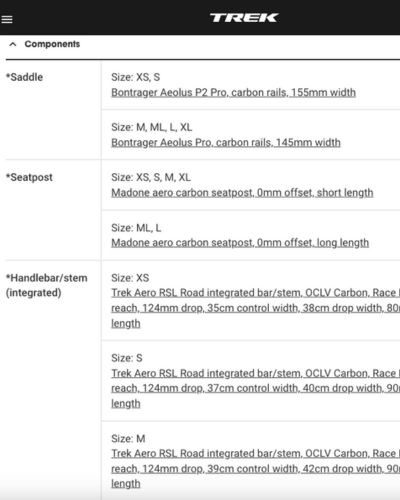
Component sizes change as bike sizes change.
2. Bike Sizes Aren’t the Same
Now that you’ve figured out your desired position, it’s time to talk sizing. You’ve probably had the experience of walking into a store to try on a shirt or pair of pants, grab your usual size off the rack, and try it on only to realize it’s not even close to fitting. Just like how a medium t-shirt doesn’t mean all that much, bike sizing is much the same… but worse.
There are two main ways that bike sizes are labeled that we’ll refer to as:
- Numerical Sizes
- This is the more traditional sizing convention for bikes.
- For road/gravel bikes typically listed in centimeters (e.g. 48, 52, 58, etc)
- For mountain bikes typically listed in inches (e.g. 15”, 17.5”, 20”, etc)
- T-Shirt Sizes
- A sizing convention that is becoming increasingly more popular in recent years.
- The size is listed in a form of “t-shirt” size like XS, S, M, L, etc.
If you’ve been cycling for a long time now, the numerical sizing is probably what you’re more familiar with. We often hear from riders that they are definitively a “Xcm” size no matter what. Unfortunately, the numerical sizes often lull riders into a false sense of confidence as these numbers appear to relate to an actual measurement on the bike. It also leads riders to believe a 52cm size would be consistent across brands, when in fact, it isn’t even consistent across different models within the same brand. While the numerical system may have been more consistent years ago, these sizes now refer to a general ballpark of size, but little beyond that.
(insert cannondale geo chart pic I need to make)

Two different models of 54cm sized bikes from the same brand.
T-shirt sizing has increased in popularity in recent years. For better or worse it essentially forces the buyer to look past the size label and hopefully better understand the frame geometry of the bike they are considering. A “medium” Canyon Aeroad doesn’t attempt to say anything about the geometry, and therefore, the buyer has to look at more important details like stack measurements, reach measurements, and more.
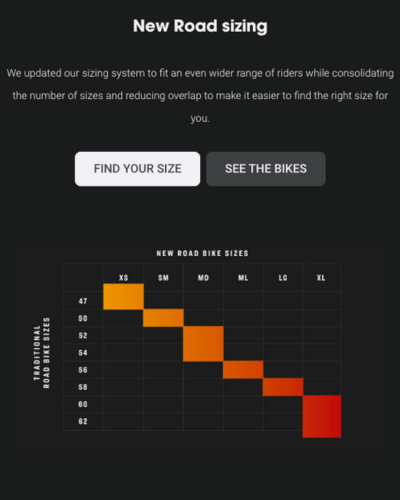
More and more brands moving towards t-shirt sizing.
It is extremely important to remember this lesson when looking at all bikes because a medium Canyon Aeroad will not be the same as a medium Trek Madone. Take every bike case by case, and always double check the geometry to compare them and understand how the bike will actually fit you. You will likely have a spectrum of sizes that work for you for many models, and this will help you rule out certain models or brands if you can’t seem to find a size with the right geometry for your desired position.
Find out your best size(s) for all your favorite bikes with our fit first Sizing Tool. Get Sized.
3. Height Isn’t Everything
Last but not least, please understand that height isn’t everything! There is no doubt that the first place to start when choosing the right size bike is with your height. Most bike manufacturers provide sizing charts for all of their bikes where rider height is the determining factor for choosing bike size. For many riders this will help select the right size, and at the very least it will get you close. However, height isn’t everything, and stopping there can lead you to select the wrong or less than ideal size.
Sizing charts that include your inseam measurement are slightly more accurate by helping to establish in broad terms if you have proportionally longer legs or torso. Especially when you’re close to the limit of one size or another, this can be a helpful piece of information in choosing which size will be best. But as mentioned earlier, your target position is key, which no one can tell from your height or your inseam.
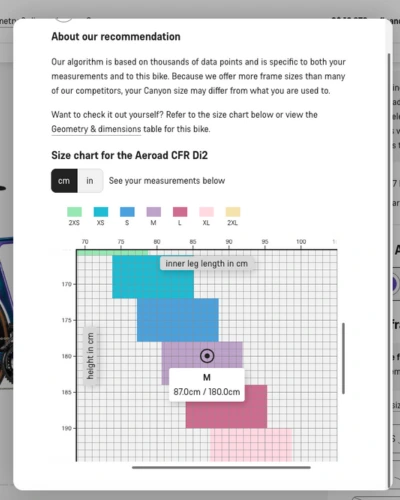
This size guide includes inseam, but it’s still missing a lot of information.
Let’s run through an example of how choosing based on height can cause you to choose the wrong size. I am 180cm and on Trek’s website, it would recommend I choose a size Large (~58cm). Now what if I have short legs and a longer torso? I might not be able to get the seat post low enough for an effective position. What if I plan to use this bike for triathlons, and I want to attach clip-on aero bars? The reach would be extremely long and potentially make clip-on aero bars difficult to use effectively. Always take your desired position and riding goals into consideration before choosing based on height.
There’s a lot more that goes into choosing the right bike, but these three points will help you avoid some of the most common mistakes we see. Just remember — bike sizing isn’t black and white. Most models have a range of sizes that can work depending on how you want to ride. So slow down, think about your position, and take a close look at the geometry. And when you’ve landed on a bike, come back and get fitted. Right size + proper fit = better rides, fewer issues, and more fun!