





Back pain while cycling is a frustrating issue experienced by many cyclists. There can be many causes and the symptoms can range from mild discomfort to debilitating pain preventing the cyclist from riding. Back pain related to cycling can also occur either during the ride or take some time to present after the ride. Back pain can refer to pain anywhere from the upper back to the tailbone. In this post we’ll focus on the mid-back downward, while technically “back pain” consists of pain above the mid-back, the causes of upper back pain more commonly relate to the same causes as neck pain and therefore will be covered in our neck and shoulder pain post.
The good news is most types of cycling related back pain can be prevented and some small adjustments can go a long way to improving your comfort. In this post we’ll look at the most common causes and solutions. Keep in mind sometimes back pain can be related to other issues on the bike. Check out our common causes series here.
This post will focus on the most common causes of back pain on the bike:
- Saddle height
- Handlebar position relative to the saddle
- Posture
- Inadequate strength and mobility
Saddle Height
Saddle height is one of the most common causes of back pain and luckily is one of the easiest adjustments to make. Simply ensuring your saddle is in the correct position can go a long way to prevent back pain.
An excessively high saddle can have the following impacts on back comfort.
- An excessively high saddle can reduce stability on the saddle and result in corresponding low back issues.
- An excessively tall saddle can add strain through the posterior chain as the rider overreaches through the bottom of the pedal stroke, thereby pulling on the low back.
- A high saddle results in the handlebars being lower relative to the saddle, which can strain the low back. Raising the saddle without a corresponding increase of the handlebar height results in an effective increase in saddle to handlebar drop.
An excessively low saddle can have the following impacts on back comfort:
- An excessively low saddle can affect the ability to hinge at the hips causing the rider to flex at the mid back to reach their handlebars.
- A low saddle can also force the rider to use primarily their lower back and upper gluteal region to pedal causing a reduction in power and potential for low back pain.

Saddle height is one of the first things to check
Solution: Ensure proper saddle height
Ensuring your saddle height is within a proper range for you is the easiest way to begin to tackle cycling back pain.To check your saddle height use an online bike fit tool like MyVeloFit and start by reviewing your knee extension angle as well as the fore/aft recommendations.
A higher knee extension angle signals a lower effective saddle height and a lower knee angle signals a higher saddle*. We almost universally recommend starting with your saddle on the low end of the range (resulting in a higher knee angle) and then progressing up from there. This is especially true if you are having back issues.
Handlebar Height
Handlebar height can refer to the absolute height of the handlebar from a set point like the bottom bracket, or relative to the saddle height (often referred to as handlebar drop).
Too much handlebar drop is the most common handlebar related issue we see causing back pain.
- Having too much handlebar drop can often result in pain in the low back due to excess spinal flexion.
- While spinal flexion may be correct, having a tight posterior chain may mean excess handlebar drop puts a strain on back resulting in aches and pains.
It is rare for back pain to be caused by handlebars being too high but it does occasionally happen in more extreme circumstances.
- Handlebars too high can result in compression of the spine and is typically felt in the low back area and is relieved by switching to the drops or bending the elbows.

Handlebar height is a common cause of back pain while cycling
Solution: Ensure proper handlebar height
To check your handlebar height the primary measurement you’ll review is your back angle, also sometimes referred to as torso angle
- A lower back angle implies that your handlebars are lower relative to the saddle. Raising your handlebars will raise your back angle.
- Generally if you are experiencing back pain, err on the side of a higher back angle (while still staying within the recommended ranges for you).

Excessive Handlebar reach
While handlebar height is the most common culprit for back pain, handlebar reach can also cause similar issues.
- Too much handlebar reach can lead to excess flexion at the low back or mid back, but more frequently excessive handlebar reach causes neck and shoulder pain. Handlebar reach is more likely to cause mid and low back issues if combined with excessive handlebar drop.
- Having the handlebars too close very rarely causes back pain.
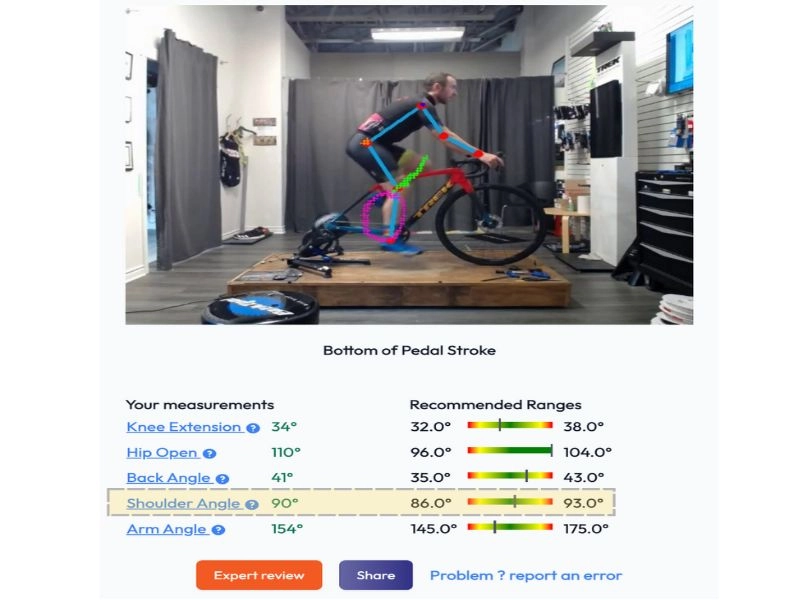
Handlebar reach is also a common cause
Solution: Reduce handlebar reach
- Check your handlebar reach by reviewing your shoulder angle.
- A higher shoulder angle implies that your handlebars are further away, while a lower angle implies that your handlebars are closer.
- If you are experiencing back pain err on the side of a lower shoulder angle (handlebars closer).
Poor Cycling Posture
The above causes and solutions focus on the position of your bike being the root of your back pain. Sometimes the position may be correct but how you hold yourself on the bike may be what’s causing your pain. In this case we want to make sure poor cycling posture isn’t resulting in pain or injuries.
Before we talk about why you may have bad posture on the bike we must first understand what good cycling posture is. Good cycling posture entails having:
- Relaxed arms and shoulders
- Slight flexion through the mid-back
- Forward bend coming from hips, not low back
- Slightly engaged core
Some key indicators of bad cycling posture are:
- Hunched shoulders
- Excessive extension at the neck or low back
- Excessive mid back flexion
- Completely extended and locked arms
There are three main reasons for having poor posture on the bike. They are:
- The position is outside of the ability level of the rider, causing them to “contort” to hold adequately reach the touch points
- Habit. The rider hasn’t taken the time to get their body used to proper posture.
- Strength. The rider gets fatigued holding the posture and regresses to a poor position.

It’s important to review your posture
Solution: Improve Riding Posture
- The first step to fixing poor posture on the bike is to determine what is causing it. The most common reason for poor posture is that the bike isn’t in the right position for your mobility level so start by reviewing your saddle and handlebar position. To do this you’ll ensure your knee angle, fore/aft, back angle and shoulder angle are in range.
- If your key measurements are in range and you are still displaying poor posture then the next step is to determine if the causes are habit or the inability to hold a good posture for the duration of your ride.
- If you start a ride with good posture but as you ride it gets worse it is likely a strength limiter. In this case we would recommend adding some strength and mobility work to help improve your ability to maintain a good posture.
- If on the other hand you never even start with good posture it could be that you never took the time to build the habit of sitting on your bike properly. In this case we recommend anchoring a posture reminder to the start and finish of each ride. Spend 5 minutes focusing on maintaining good posture when you start riding and finish riding and you’ll be surprised how quickly your posture may improve.
Inadequate strength and mobility
Most of the above points have focused on back pain being caused by your cycling position. There are occasions however where there is nothing wrong with the position but riding still causes back pain. In these cases the physical act of pedaling or maintaining your position on the bike is what causes the pain. While it can be the case that the position is too aggressive for your strength and mobility, we consider that a position issue rather than a strength and mobility issue, the following causes and solutions will assume that the bike position is optimal for your ability and the pain is solely strength and mobility based.

The Importance Of Mobility For Cyclists
Solutions: Strength and Mobility Training
- First and foremost make sure you have ruled out each of the causes mentioned above by ensuring your saddle and handlebar height are in the correct position for you and your mobility level.
- Add regular strength and mobility work to your routine. An easy way to do this is through Dynamic Cyclist an online service with strength and mobility sessions designed specifically for cyclists.
- If you have ruled out the above causes and you’ve done some mobility work and are still experiencing back pain it may be worth working with a health professional to ensure there are no other problems that need to be addressed.
*MVF measures the complementary knee angle if you are used to seeing supplementary knee angles simply subtract the reported angle from 180.