







The Union Cycliste Internationale (UCI) recently announced new regulations around handlebar width that we believe are not only poorly conceived, but may also carry unintended and harmful consequences—particularly for women and smaller riders. We strongly disagree with the new regulations and have started a petition to the UCI for them to alter the new rules to make them more inclusive to all riders. Please take a moment to sign the petition and share it amongst your fellow riders.

Take a moment to sign and share the petition to revise the new regulations.
What’s Changing?
The UCI’s updated rule mandates:
- A minimum outside-to-outside handlebar width of 40cm, and
- A minimum inside-to-inside distance of 32cm at the narrowest point of the brake levers.
While the 40cm outside width rule is less problematic—especially if measured with bar tape (a detail not yet clarified)—the 32cm lever width requirement poses serious biomechanical and inclusion-related concerns.

You may be surprised how narrow the inside-to-inside lever measurement is on your bike.
Our Data Tells a Different Story
At MyVeloFit, we maintain the world’s largest database of cyclist fit data. After hearing about the rule, we did a bit of our dive into our data to see what the impact of this regulation might be. According to our analysis, the average optimal handlebar width for women is 38cm, notably narrower than the new 40cm minimum. This average doesn’t necessarily take into consideration professional riders who typically have a thinner build versus the general population.
Biomechanically, riders benefit from a modest internal lever rotation to achieve wrist-neutral positions. Many modern brake levers, such as Shimano’s Di2, include internal bends that effectively reduce the inside width even without internal rotation, putting riders at risk of non-compliance. Preventing this setup increases the likelihood of nerve impingement and overuse injuries, particularly in the wrist and hands. The regulation will either force riders to endure the pain, or go to an excessively wide handlebar to achieve a better wrist angle, which could cause other issues in the shoulders and neck.
One Size Doesn’t Fit All
In typical UCI fashion, not a lot of information was shared about the motivation for the change. To be fair, we have seen some pretty extreme narrow setups in the men’s peloton that previous regulations have already fixed. We believe the rationale behind the rule change appears to focus on:
- Reducing extreme aerodynamic positions, and/or
- Curbing dangerously narrow bar setups that impair handling.
While we understand these safety concerns as professional cycling has gotten faster and faster, the UCI’s approach applies a blanket solution that fails to account for a significant segment of the cycling population. One wide sweeping regulation does not suit everyone, and fails to consider the entire women’s peloton.
Ironically, forcing all riders to a 40cm minimum width may create more handling problems, not fewer—particularly for smaller athletes for whom wider bars cause instability, poor posture, and increased injury risk.

Biological shoulder width between men and women should be considered in regulations.
The Impact on Women and Small Riders
Make no mistake: this rule disproportionately impacts women. Time and time again in sport, we see governing bodies mandate rules and regulations that don’t consider women athletes. The average woman, even at the elite level, often requires a bar width smaller than 40cm. By enforcing this rule:
- Women are discouraged from participating or competing due to poor fit and increased injury risk.
- Riders who previously had optimized, safe, and performance-enhancing setups will be forced into suboptimal positions.
- We anticipate a rise in preventable overuse injuries, as athletes are forced into unnatural postures.

The new regulation disproportionately effects women’s cycling.
A Better Path Forward: Data-Informed Regulation
We believe in evidence-based bike fitting and policy-making. If the UCI believes a minimum lever width is necessary, we propose a 28 cm minimum inside-to-inside lever width. This range would accommodate the vast majority of riders, and particularly smaller athletes and women. Some other potential regulations we’d suggest would be having men’s and women’s specific regulations, or handlebar width minimums based on shoulder width One approach to that could be similar to the UCI’s approach on TT bike setup and height. Riders could have specific handlebar requirements based on their measured shoulder width. All of these suggestions would also address the safety concerns and need for this regulation while preserving handling integrity by allowing riders to choose handlebars that suit their frame size.
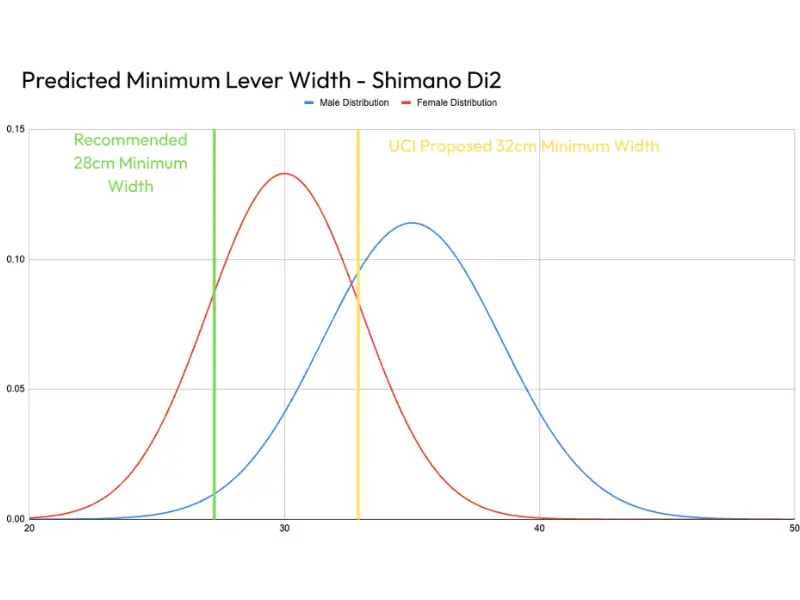
A 28cm inner width minimum would work for majority of riders.
Conclusion
Cycling should be inclusive, safe, and built on sound biomechanics. Rules that ignore human diversity in favor of uniformity do a disservice to the athletes they aim to protect. We have created a petition urging the UCI to revisit this regulation and work collaboratively with fit professionals, sports scientists, and the riders to develop standards that prioritize performance, health, and inclusion—for everyone. We’d greatly appreciate you taking a moment of your time to sign the petition and share it amongst your fellow riders.